Blog

  • Here Is SoFi's Multibillion-Dollar Opportunity That Investors Are Overlooking

    Key Points

    • SoFi’s revenue is growing rapidly, and there are several reasons why.

    • Third-party personal loan originations, checking and savings accounts, and other growth drivers are responsible.

    • Home loans aren’t a large part of SoFi’s business right now, but that could change in 2026.

    To say that SoFi (NASDAQ: SOFI) has grown impressively would be an understatement. Over the past three years, SoFi’s membership base has grown by 142%, revenue has grown by even more, and the company is now consistently profitable.

    A few major growth drivers have been responsible for the stellar recent performance. Personal loan originations have soared, and net chargeoffs have declined. The “loan platform business” that originates loans on behalf of third parties and provides referrals to partners has become a rapidly growing source of high-margin fee income. And the SoFi Invest platform has launched some exciting features, such as options trading and access to private companies. These are just a few examples.

    Where to invest $1,000 right now? Our analyst team just revealed what they believe are the 10 best stocks to buy right now, when you join Stock Advisor. See the stocks »

    One future billion-dollar revenue stream

    For the time being, personal loans are by far the largest part of SoFi’s lending business, accounting for about 77% of loan originations through the first three quarters of 2025. Student loans, the original loan type marketed by the company, is the second largest.

    Aerial view of SoFi Stadium.

    Image source: SoFi.

    However, one part of SoFi’s business that is overlooked, and shouldn’t be, is home loans.

    To be sure, I wouldn’t call SoFi a major mortgage lender by any definition. The company originated about $2.3 billion in mortgages over the past three quarters. For context, Rocket Companies (NYSE: RKT) originated $32.4 billion during the most recent quarter alone.

    Although home loans aren’t a big part of SoFi’s business yet, it’s tough to overstate what a massive opportunity this is. For one thing, the real estate market itself is still historically slow, as interest rates have remained high. Not only is home purchase activity slow, but refinancing is, too.

    Second, as SoFi’s member base grows, it creates cross-selling opportunities for other products, including home loans. In fact, in the most recent quarter, SoFi’s home loan volume nearly doubled from $490 million to $945 million, so it’s already seeing quite a bit of traction.

    As rates (hopefully) come down over the next couple of years, and SoFi’s ecosystem grows by millions of new members, it could create a perfect storm of home loan demand. SoFi could even replicate its personal loan platform and incorporate third-party mortgage originations and referrals. In a typical year, roughly $6 trillion worth of existing homes are sold in the United States. Plus, American homeowners are sitting on $35 trillion in home equity, the most in history. SoFi is well positioned for its home loan business to grow significantly in the years to come.

    Should you buy stock in SoFi Technologies right now?

    Before you buy stock in SoFi Technologies, consider this:

    The Motley Fool Stock Advisor analyst team just identified what they believe are the 10 best stocks for investors to buy now… and SoFi Technologies wasn’t one of them. The 10 stocks that made the cut could produce monster returns in the coming years.

    Consider when Netflix made this list on December 17, 2004… if you invested $1,000 at the time of our recommendation, you’d have $470,587!* Or when Nvidia made this list on April 15, 2005… if you invested $1,000 at the time of our recommendation, you’d have $1,091,605!*

    Now, it’s worth noting Stock Advisor’s total average return is 930% — a market-crushing outperformance compared to 192% for the S&P 500. Don’t miss the latest top 10 list, available with Stock Advisor, and join an investing community built by individual investors for individual investors.

    See the 10 stocks »

    *Stock Advisor returns as of January 22, 2026.

    Matt Frankel, CFP has positions in Rocket Companies and SoFi Technologies. The Motley Fool has positions in and recommends Rocket Companies. The Motley Fool has a disclosure policy.
  • BigBear.ai Investors Need to Know These Two Key Risks

    BigBear.ai (NYSE: BBAI) is positioning itself at the center of secure AI and defense adoption, with new partnerships and recurring revenue potential. The upside is compelling, but dilution and weak operating profits create real riskthat investors cannot ignore.

    Stock prices used were the market prices of Jan. 19, 2026. The video was published on Jan. 21, 2026.

    Where to invest $1,000 right now? Our analyst team just revealed what they believe are the 10 best stocks to buy right now. Continue »

    Should you buy stock in BigBear.ai right now?

    Before you buy stock in BigBear.ai, consider this:

    The Motley Fool Stock Advisor analyst team just identified what they believe are the 10 best stocks for investors to buy now… and BigBear.ai wasn’t one of them. The 10 stocks that made the cut could produce monster returns in the coming years.

    Consider when Netflix made this list on December 17, 2004… if you invested $1,000 at the time of our recommendation, you’d have $470,587!* Or when Nvidia made this list on April 15, 2005… if you invested $1,000 at the time of our recommendation, you’d have $1,091,605!*

    Now, it’s worth noting Stock Advisor’s total average return is 930% — a market-crushing outperformance compared to 192% for the S&P 500. Don’t miss the latest top 10 list, available with Stock Advisor, and join an investing community built by individual investors for individual investors.

    See the 10 stocks »

    *Stock Advisor returns as of January 22, 2026.

    Rick Orford has no position in any of the stocks mentioned. The Motley Fool has no position in any of the stocks mentioned. The Motley Fool has a disclosure policy. Rick Orford is an affiliate of The Motley Fool and may be compensated for promoting its services. If you choose to subscribe through their link, they will earn some extra money that supports their channel. Their opinions remain their own and are unaffected by The Motley Fool.

  • Will Nike Stock Ever Be a Winner Again?

    Key Points

    • Nike has lost more than half its value in the past five years.

    • The stock is facing headwinds like U.S. tariffs and declining revenue in China.

    • Its CEO has a turnaround plan, but the athletic footwear market might be in decline.

    Nike (NYSE: NKE) is an iconic brand that has launched world-famous products and eye-catching ad campaigns. But the apparel company, known for Air Jordans and other celebrity athlete endorsements, is struggling to gain liftoff in today’s consumer economy.

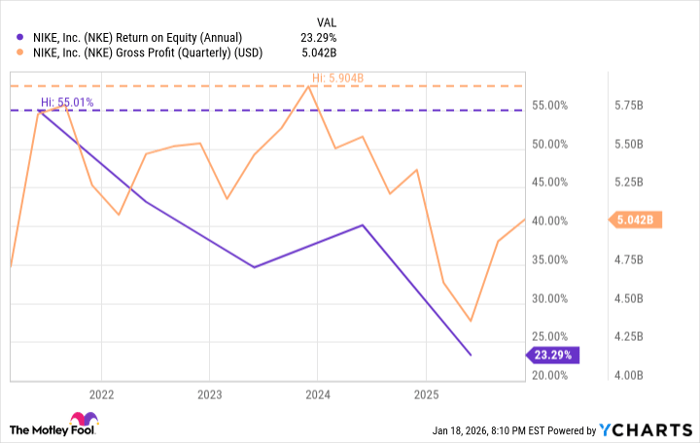
    Nike stock is down 53% in the past five years. In the past four years, its return on equity has dropped from 43.1% in 2022, to 23.3% in 2025. The company’s quarterly gross profits have mostly gone in the wrong direction since 2023.

    Where to invest $1,000 right now? Our analyst team just revealed what they believe are the 10 best stocks to buy right now. Continue »

    NKE Return on Equity (Annual) Chart

    NKE Return on Equity (Annual); data by YCharts.

    What happened to the stock, and can it ever recover? Let’s look at the latest trends shaping the business’ performance, why this consumer discretionary stock has suffered, and whether investors should feel confident or cautious about Nike’s future.

    Nike is being hit by tariffs

    Just like many other apparel stocks, Nike is vulnerable to tariffs because it imports its shoes to the U.S. from a global supply chain. On its quarterly earnings call in September 2025, management said it expected tariffs to cost it $1.5 billion in fiscal year 2026, with a tariff-related reduction of 1.2% to its gross margin.

    'If current economic challenges blossom into a full-blown recession, it could hit Nike's turnaround efforts at a particularly difficult time.' -Team Rule Breakers, The Motley Fool

    Image source: The Motley Fool.

    Nike is facing tough competition in China

    The company announced its latest earnings for the second quarter of fiscal 2026 on Dec. 18, 2025. Even though earnings per share beat analysts’ expectations, the stock price dropped 10% the day after the earnings call. That drawdown was driven by disappointing news from China, where the quarter’s total revenue from the Greater China market were down 17% compared to the previous year.

    This is a sign that China is becoming an increasingly important market for Nike. If Chinese consumers stop buying its shoes, the company’s future growth could stall.

    Consumers are more price-sensitive about shoes

    The company wants to be a premium brand that can charge full price for its shoes. CEO Elliott Hill was hired in October 2024 to lead a turnaround. He is working to undo moves made by the previous leadership, which focused on helping expand its e-commerce by selling shoes directly to consumers online at a discount. Now, Hill is embracing a strategy of rebuilding Nike’s relationships with its wholesale channel partners and regaining shelf space at brick-and-mortar retailers.

    But Nike and other shoe brands might face some challenges in raising prices. U.S. consumers seem to be getting choosier about how much they spend on shoes. The Footwear Distributors and Retailers of America (FDRA) released survey data in October 2025 showing that 48% of U.S. consumers were not planning to buy footwear during the 2025 holiday season, and 65% of likely shoe shoppers agreed that tariffs were a major reason why prices had gone up.

    An FDRA survey of shoe executives this month shows that many tariff-related cost increases for shoes are still in the early stages. It found that 29.8% of shoe executives expect their average retail price to go up by 6% to 10%, while another 14.9% expect their average retail price to increase by more than 10%.

    If shoe prices go up in a way that makes price-conscious customers close their wallets, Nike might struggle to regain its pricing power. And that could put downward pressure on margins.

    Sports “casualization” could be ending

    Athletic footwear brands built their businesses in part because of changing consumer behavior around wearing athletic shoes outside of the gym. They have become everyday casual wear at home and office for millions of people.

    But if consumer styles and preferences change, this trend could fade away. If shoppers stop thinking it’s cool to wear sports shoes in casual settings, Nike’s business could suffer.

    Recent research from Bank of America shows that this “casualization” trend in wearing athletic shoes might not have any more room to run. The bank’s analysts said that sneakers already represent about 50% of global footwear sales, and U.S. participation in sports is not growing. If the market for casual sports shoes is already saturated, this could be bad news for Nike and other athletic apparel brands.

    People love sneakers, so it’s hard to believe that the global market for athletic shoes will severely decline anytime soon. But Nike can’t count on brand awareness alone to drive growth. It needs to innovate and create a new generation of must-have shoes that get people to wait in line at the mall. If not, the company is facing strong headwinds that could lead to a future of low growth and shrinking margins.

    Should you buy stock in Nike right now?

    Before you buy stock in Nike, consider this:

    The Motley Fool Stock Advisor analyst team just identified what they believe are the 10 best stocks for investors to buy now… and Nike wasn’t one of them. The 10 stocks that made the cut could produce monster returns in the coming years.

    Consider when Netflix made this list on December 17, 2004… if you invested $1,000 at the time of our recommendation, you’d have $470,587!* Or when Nvidia made this list on April 15, 2005… if you invested $1,000 at the time of our recommendation, you’d have $1,091,605!*

    Now, it’s worth noting Stock Advisor’s total average return is 930% — a market-crushing outperformance compared to 192% for the S&P 500. Don’t miss the latest top 10 list, available with Stock Advisor, and join an investing community built by individual investors for individual investors.

    See the 10 stocks »

    *Stock Advisor returns as of January 22, 2026.

    Bank of America is an advertising partner of Motley Fool Money. Ben Gran has no position in any of the stocks mentioned. The Motley Fool has positions in and recommends Nike. The Motley Fool has a disclosure policy.

  • 2 Top Cybersecurity Stocks to Buy in January

    Key Points

    • AI-enabled cyberattacks increased 72% in 2025.

    • Palo Alto has a very profitable security business and is expanding its footprint with its Cyberark purchase.

    • Microsoft is the largest cybersecurity company by revenue.

    Security threats are constantly rising and getting more sophisticated, thanks to bad actors utilizing artificial intelligence (AI). AI-enabled cyberattacks increased an estimated 72% in 2025 and that’s led to a rapid increase in the number of companies using AI to fight threats, with about two-thirds now doing so.

    As security complexities increase, cybersecurity companies are more important than ever, driving what will become a $377 billion market by 2028, according to IDC. As companies rise to meet the increasing threats, investors have the potential to benefit from the companies leading the pack. Here’s why Palo Alto Networks (NASDAQ: PANW) and Microsoft (NASDAQ: MSFT) are two of the best cybersecurity stocks to buy right now.

    Where to invest $1,000 right now? Our analyst team just revealed what they believe are the 10 best stocks to buy right now. Continue »

    A person looking at a screen with a lock on it.

    Image source: Getty Images.

    Palo Alto continues to expand its security footprint

    Palo Alto recently made a very significant move to expand its security lead by purchasing Cyberark Software for $25 billion. The move helps the company, which was already a leader in cybersecurity, expand its footprint in identity and access control. The move, while pricey, means Palo Alto can offer a comprehensive cybersecurity solution to its clients, once the deal closes in the next few months.

    But it’s worth mentioning that Palo Alto would already be a top cybersecurity company even without the purchase. In the fiscal first quarter (which ended Oct. 31), the company’s sales rose 16% to $2.5 billion, and its non-GAAP (adjusted) net income rose by 19% to $0.93 per share.

    Palo Alto’s business is highly profitable, with management reporting another quarter of an approximately 30% operating margin and guiding toward an adjusted free-cash-flow margin of 40% or higher by fiscal 2028. With the company’s profitability already high and Palo Alto on the verge of closing its Cyberark deal to expand its security services, shareholders have a lot to look forward to.

    Microsoft isn’t just an AI and cloud company

    Microsoft is best known for its Azure cloud computing business, its growing influence in artificial intelligence with Copilot, and its Microsoft 365 software offerings. That’s important to note because the AI cloud market is estimated to reach $2 trillion globally by 2030.

    But the company is also an important player in the cybersecurity space, with 1.5 million cybersecurity customers globally. Microsoft has an Azure Security service it offers to its cloud customers, allowing the company to benefit from both hosting clients’ cloud networks and their need to secure them.

    In 2025, Microsoft earned an estimated $37 billion in cybersecurity sales, which accounted for about 14% of its total sales, making it the largest cybersecurity company by revenue. If it continues to grow at a similar rate, Microsoft could reach $50 billion in security sales by 2030.

    Microsoft is already delivering strong results for shareholders. Revenue climbed 18% year over year to $77.7 billion, in its fiscal first quarter of 2026, ended Sept. 30, 2025, while non-GAAP earnings surged 22% to $30.8 billion. By capitalizing on the rapid adoption of AI — and the growing demand for security services that protect AI-driven cloud infrastructure — Microsoft is well positioned to continue rewarding shareholders as it evolves into an increasingly key player in cybersecurity.

    One quick note about cybersecurity stocks

    All tech stocks can be volatile, but cybersecurity stocks sometimes fall on news of security breaches. No cybersecurity system is foolproof, so some breaches are inevitable. But as long as Microsoft and Palo Alto deal with any problems quickly and no lasting damage is done, investors shouldn’t panic-sell when cyberattacks occur.

    Should you buy stock in Palo Alto Networks right now?

    Before you buy stock in Palo Alto Networks, consider this:

    The Motley Fool Stock Advisor analyst team just identified what they believe are the 10 best stocks for investors to buy now… and Palo Alto Networks wasn’t one of them. The 10 stocks that made the cut could produce monster returns in the coming years.

    Consider when Netflix made this list on December 17, 2004… if you invested $1,000 at the time of our recommendation, you’d have $460,340!* Or when Nvidia made this list on April 15, 2005… if you invested $1,000 at the time of our recommendation, you’d have $1,123,789!*

    Now, it’s worth noting Stock Advisor’s total average return is 937% — a market-crushing outperformance compared to 194% for the S&P 500. Don’t miss the latest top 10 list, available with Stock Advisor, and join an investing community built by individual investors for individual investors.

    See the 10 stocks »

    *Stock Advisor returns as of January 22, 2026.

    Chris Neiger has no position in any of the stocks mentioned. The Motley Fool has positions in and recommends Microsoft. The Motley Fool recommends Palo Alto Networks and recommends the following options: long January 2026 $395 calls on Microsoft and short January 2026 $405 calls on Microsoft. The Motley Fool has a disclosure policy.

  • 3 Places You Should Never Keep Your Emergency Savings Fund

    Person hiding cash under mattress.

    Image source: Getty Images

    If your water heater explodes or your car’s transmission dies, your emergency fund is your safety net. It’s a stash of $5,000 or more that can solve money problems fast.

    But where you keep that cash matters just as much as how much you save. A good emergency fund should be safe, easy to access, and ideally earning some interest while it waits.

    Here are three places you definitely don’t want to keep it (and two you should).

    1. Under your mattress

    My grandpa used to stash rainy day money in a coffee can under the sink. And sure, keeping a little emergency cash at home can still be handy today. I keep a few $100s and some small bills at home for convenience.

    But holding thousands of dollars in your house? That’s not a smart long-term move.

    Cash at home earns zero interest, it’s not insured, and it’s way too easy to “borrow” from when you’re tempted. Worst case, a flood, fire, or break-in could wipe it out completely.

    2. In your day-to-day checking account

    The problem with mingling your savings and daily spending money is twofold:

    First, looking at a large checking balance every time you log into your banking app messes with your mind. It makes you feel flush, even when that money’s supposed to be off-limits. The temptation to spend is too much for most people to resist.

    And second, checking accounts earn practically nothing in interest. Typical big bank checking accounts pay 0.01% APY. If your emergency fund is $10,000, you’re earning… $1 over the course of a year. While inflation eats away at the real value.

    High-yield savings accounts (HYSAs) are a much better spot for your emergency fund. Compare top-paying savings account options here with APYs of 4.00%+ still available.

    3. Invested in stocks or crypto

    It’s tempting to invest your emergency fund, hoping to squeeze out some extra growth.

    But what happens if the market is down when you need to grab your cash suddenly? Imagine you’ve got $5,000 in an S&P 500 ETF, and your furnace dies mid-winter. If the market’s down 20%, you’d be forced to sell at a loss just to get warm.

    Crypto is even more volatile and risky. It can double overnight… or crash just as fast.

    So, where should you keep your emergency fund?

    Here are two solid options that check all the boxes: safe, liquid, and earning interest.

    1. A high-yield savings account (HYSA)

    These are just like regular savings accounts but they pay way more interest — some offering over 4.00% APY right now.

    The best HYSAs are typically offered by online banks, which typically have no fees, FDIC insurance up to $250,000, and allow quick money transfers to/from your checking account.

    2. CD ladders

    If your emergency fund is a bit larger and you don’t need access to all of it right away, a CD ladder might be smart.

    You basically spread your cash over different CD terms (like 3, 6, or 12 months), so that a portion of your money matures at regular intervals. Just be sure to check for early withdrawal penalties in case you do end up needing access to that cash.

    Check out all of today’s top CD rates and terms here.

    The bottom line

    True story: My brother once called me and needed $6,000 immediately (his other option was a rip-off high-interest loan.) Because I had emergency money in a high-yield savings account with wire access, I was able to help within one hour — no stress, no selling investments, no scrambling for cash.

    That’s exactly what an emergency fund is for. Sitting in a safe spot, ready to roll when unexpected stuff happens.

    Alert: highest cash back card we’ve seen now has 0% intro APR well into 2026

    This credit card is not just good – it’s so exceptional that our experts use it personally. It features a 0% intro APR for 15 months, a cash back rate of up to 5%, and all somehow for no annual fee!

    Click here to read our full review for free and apply in just 2 minutes.

    We’re firm believers in the Golden Rule, which is why editorial opinions are ours alone and have not been previously reviewed, approved, or endorsed by included advertisers.
    Motley Fool Money does not cover all offers on the market. Editorial content from Motley Fool Money is separate from The Motley Fool editorial content and is created by a different analyst team.The Motley Fool has a disclosure policy.

  • European governments turn to short-term borrowing as pension funds retreat

    Sovereign issuers are curbing sales of long-term bonds to blunt damage from higher borrowing costs

  • US companies expand protection services for top executives

    More than 20% of S&P 500 companies provided security benefits amid mounting threats

  • Trump’s Greenland pivot leaves Europe flummoxed

    EU leaders to meet as US president drops tariffs and military threat to take Arctic island from Denmark

  • Trump and Rutte discussed renegotiation of pact over US troops in Greenland

    Global markets rebound after US president retreats from threat to hit European countries with tariffs

  • ‘Thank you Tony’: Blair’s ‘Board of Peace’ role prompts Trump praise and Westminster anger

    Many countries, including the UK, have turned their backs on the project after Putin was asked to join